Transportation and Transit Agencies face the largest changes ever in their histories. Understanding how to navigate them requires a funding, a structured approach, and interaction and learning with like-minded people to deliver results.
Transportation and transit agencies are operating in a period of unprecedented disruption—policy shifts, rapid technology change, funding pressure, and rising public expectations—yet day-to-day operations remain fragmented across systems, vendors, and silos.
The Smart City Mobility Council exists to help agencies reimagine control. Through an independent, practitioner-led structure, the Council brings members together to synthesize real-world experience, reuse what works, and convert fragmented inputs into coherent, executable action.
Members gain proven frameworks, shared evidence, and operational playbooks that reduce execution risk and accelerate the transition from pilots and intent to controlled, policy-driven mobility operations with measurable results for people, businesses, and cities.
How Misalignment Creeps In
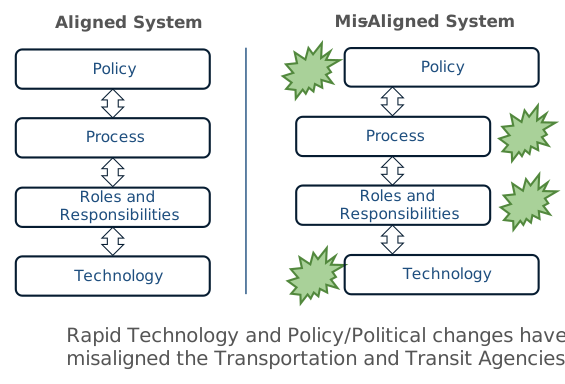
Rapid policy shifts, evolving funding models, new technologies, and rising public expectations have pushed transportation and transit agencies out of alignment. Policy, process, roles and responsibilities, and technology are often changed independently—by different organizations, on different timelines, and for different reasons. The result is a system where individual components may improve, but the overall operation becomes harder to manage, harder to explain, and harder to control.
In a mis-aligned model, agencies absorb complexity instead of directing it. Decisions are made without a shared operational framework, pilots proliferate without clear pathways to scale, and performance gaps persist despite significant investment. This misalignment is not a failure of intent or effort—it is a structural consequence of rapid change without an integrating mechanism.
The Shift to an Integrated Operational Model For Mobility
Most traffic control agencies have progressed incrementally—moving from manual control to actuated, coordinated, and adaptive signal systems. These steps improve local performance, but they do not, on their own, deliver system-wide integration, especially with transit operations. Optimization remains reactive, mode-specific, and bounded by the limitations of individual intersections or corridors.
The next-generation transportation operational model represents a structural shift. Instead of optimizing signals in isolation, agencies define explicit policy objectives and use real-time, multi-modal data to allocate green dynamically across modes and corridors. Decisions move from static plans and vendor-specific logic to policy-driven, measurable control of the network.
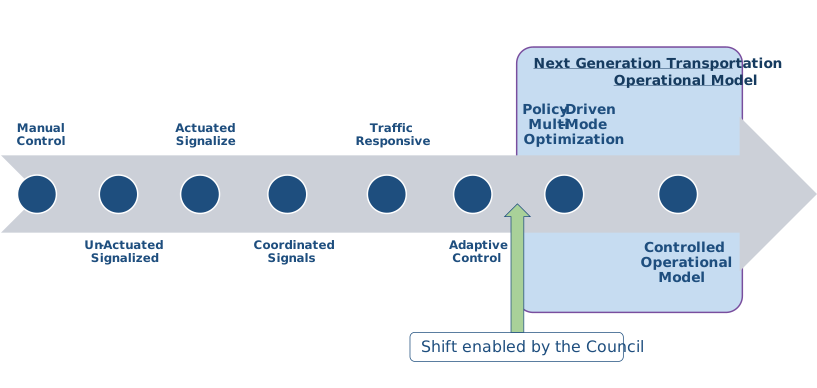
This shift is not a single technology upgrade. It is the transition from managing infrastructure to managing outcomes—where safety, transit performance, freight reliability, and overall traffic flow are actively balanced and continuously improved within a controlled operational framework.
A Proven Path from Choice to Execution

The transition from fragmented systems to Integrated operations is complex, but it is not uncharted. The Council applies a disciplined, repeatable operating cycle that moves agencies from intent to execution—linking governance, assessment, implementation, and benefit realization around the people responsible for delivery.
This approach ensures that objectives are explicit, changes are grounded in reality, and results are embedded into daily operations rather than left as one-off pilots.
Each cycle strengthens the next. As agencies apply the framework, outcomes are measured, lessons are formalized, and methods are refined and reused across the Council. What begins as individual progress becomes shared capability—reducing execution risk, accelerating delivery, and continuously improving the ability of agencies to plan, decide, and operate with confidence.
Our method is adaptive. It improves every time it is applied, leading to better outcomes and learning for all members.
Where Fragmented Inputs Become Coherent Action
Transportation agencies face many inputs but few mechanisms to turn them into action. This is where fragmented inputs become coherent action—through independent synthesis that translates complexity into controlled operations and sustained results.

The Council provides the independent structure agencies need to absorb complexity without being overwhelmed by it. By synthesizing experience, evidence, and practice across members, decisions are translated into execution and sustained, measurable outcomes.
Ultimately, this enables agencies to deliver W.I.S.E. outcomes: Wellbeing, Inclusivity, Sustainability, and Evidence of Economic Growth, for the people and businesses they serve.